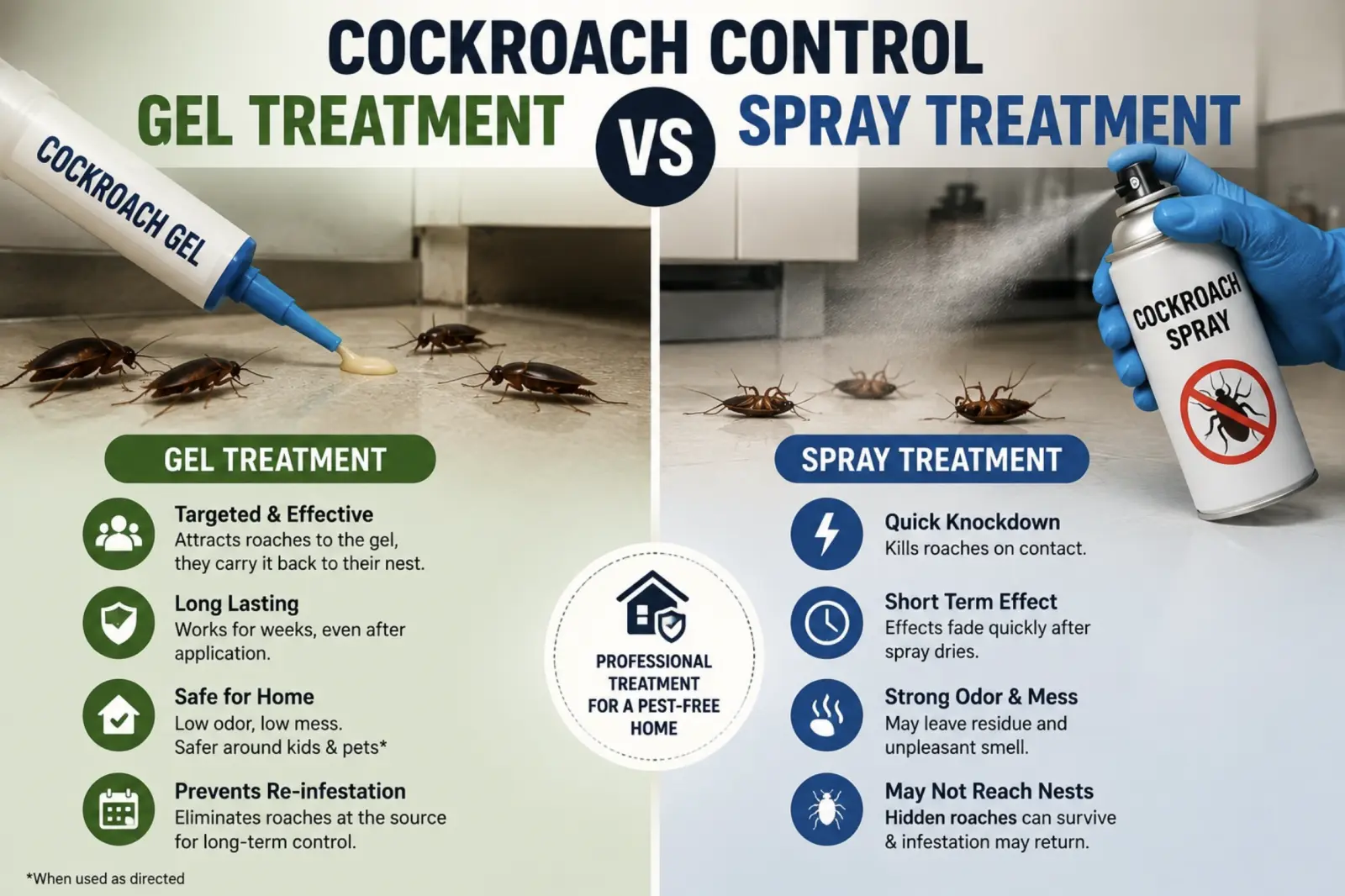
If you’ve tried every home remedy and still see roaches at night, you’ve probably wondered whether cockroach gel treatment is actually better than sprays. The honest answer is that both can work, but only when they’re used in the right way, in the right place, and for the right level of infestation.
In flats and independent houses across Bangalore and Mysore, the usual pattern is the same: a few sprays, dead roaches for a week, then they’re back. The problem isn’t always the product. It’s using the wrong method for the kind of infestation you have. Let’s break down gel vs spray so you can choose what actually clears your kitchen, not just for a few days, but for months.
Gel bait treatment targets roaches where they live and feed, instead of where you happen to see them during the day. The technician applies small pea-sized dots of gel in cracks, crevices, hinges, behind appliances, and along runways roaches use at night.
The roaches eat the bait and then carry traces of it back to their hiding spots. Other roaches feed on their droppings or carcasses and get poisoned as well. This secondary kill effect is one of the main reasons gel works so well against hidden colonies inside cabinets, wall voids, and false ceilings.
A typical cockroach spray treatment uses a liquid insecticide applied along walls, skirting, drain outlets, and exterior entry points. The chemical either kills on contact or leaves a residue that affects roaches when they walk over it later.
This kind of treatment gives a faster visible knockdown. You’ll often see dead or dying roaches within hours. But contact sprays depend heavily on coverage and application technique. Miss a few key harbourages and the population rebuilds from eggs and hidden adults.
When comparing cockroach gel treatment to sprays, think about where your roaches actually live. In most Bangalore apartments, German cockroaches nest inside kitchen cabinets, near warm appliances, and in electrical panels. These are closed, cluttered spaces where sprays rarely reach safely.
Gel can be placed precisely in these spots. It doesn’t drip, doesn’t stain most surfaces, and doesn’t need you to vacate the house in most cases. Sprays, on the other hand, are better for perimeter control, drains, and high-movement areas where roaches travel between flats or from outside.
The main advantage of cockroach killer gel is how targeted it is. You use very small amounts, placed where roaches actually feed. That means lower smell, less mess, and less exposure for kids and pets compared to heavy spraying.
The downside is that gel works through feeding, not instant contact. So if your infestation is very heavy, you may not see a dramatic pile of dead roaches the first night. Results build over 7–10 days as more of the colony feeds on the bait, which requires a bit of patience and correct placement.
Sprays shine when you need quick knockdown of visible roaches in open areas, like in a store room, balcony, or common corridor. They also support broader cockroach pest control by reducing movement between units in an apartment block.
The flip side is overspray and residue on utensils, countertops, and children’s areas if the applicator isn’t careful. In many homes the spray is applied only where it’s easy to reach, not where roaches hide, so the nest survives and the problem feels "unsolvable".
If you’re looking at home cockroach treatment for a standard 2BHK in Bangalore, start by checking where you actually see activity. Roaches in cabinets, near the fridge compressor, under the sink, and behind the gas stove usually respond best to gel.
Sprays are more useful when you notice roaches coming in from bathroom drains, service ducts, and the building’s garbage area. In that case, combining gel indoors with a controlled spray on external entry points can shut down both the nest and the incoming traffic.
A professional cockroach treatment doesn’t blindly spray every wall and hope for the best. Good technicians inspect first, identify species and harbourages, and then decide where gel makes sense and where a residual spray is needed.
Done properly, gel is used in sensitive indoor spots like kitchen cabinets, while sprays are kept to drain outlets, service shafts, and external perimeters. This reduces chemical load inside the home while still cutting off new roaches from neighbouring units.
For light infestations, especially in newer flats, a careful DIY approach can work. You can apply gel in small dots inside hinges, under the sink, and behind the fridge, then monitor activity for 7–14 days before deciding if you need a cockroach exterminator.
The problem comes when you’re already seeing roaches during the day, or spotting egg cases and droppings in multiple rooms. That usually signals a well-established colony that’s been there for months, not weeks, and in those cases a structured, professional plan is worth the cost.
In Bangalore and Mysore, a professional cockroach removal service for a typical 2BHK or 3BHK often takes about an hour on site, with follow-up in 15–30 days if needed. Pricing varies by provider, but the big difference isn’t the chemical—it’s the inspection and method.
Cheap one-time "spray and go" jobs often skip gel completely, or use it in random spots. A better service combines both methods, seals obvious entry points, and gives aftercare instructions so you don’t undo the work with poor storage and cleaning habits.
Gel and spray are just two tools among several pest control methods you can use against roaches. For example, insect growth regulators can stop eggs from developing, and sticky monitors help track where activity is highest before treatment.
In practice, your choice comes down to three factors: how bad the infestation is, how sensitive the space is (small kids, pets, allergies), and how much time you’re willing to invest in preparation and follow-up after the visit.
There are a few clear signals that home measures aren’t enough. Seeing roaches in broad daylight, smelling a musty odour from cabinets, or finding droppings near appliances all point to a heavy infestation that needs structured cockroach pest control.
If you’re in a building where neighbours also have complaints, trying to handle the problem in just one flat with off-the-shelf products often leads to a cycle of temporary relief and quick reinfestation.
Both gel and spray have their place, but for kitchens and bedrooms in Bangalore and Mysore, cockroach gel treatment usually gives cleaner, longer-lasting control with less disruption to daily life. The key is using it in the right locations and backing it up with basic hygiene so you’re not feeding the next generation of pests.
If your infestation is already moderate to heavy, or you’re tired of experimenting with products, bringing in a local expert like Kiran Enterprises to plan the mix of gel, spray, and follow-up visits is often the fastest way to reclaim your home from roaches.
Get a same-day inspection from our certified technicians.
Chat on WhatsAppOr call +91 98452 73699